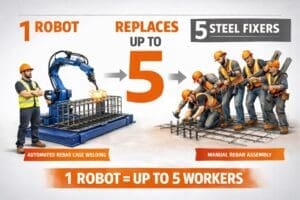
Even in operations where work is priced per kilogram, the true cost of reinforcement assembly is often underestimated.
On the surface, the model seems straightforward: pay per output, ensure productivity. But the reality on the shop floor tells a different story.
Wages are steadily increasing.
Labour shortages are becoming more pronounced each year.
And skilled steel fixers – once readily available – are now increasingly difficult to find.
At the same time, the nature of the work hasn’t changed.
Reinforcement assembly remains physically demanding. It requires long hours spent bent over, tying or welding thousands of connections every single day. This raises an important question about sustainability—not just for businesses, but for the workforce itself.
It also leads to another, perhaps more forward-looking question:
Would younger workers today choose to spend their day tying wire and welding bars…
or would they rather supervise and operate modern, automated equipment?
Many reinforcement shops still operate under the assumption that paying per kilogram is enough to ensure efficiency.
But productivity is not just about how much is produced – it’s about how it is produced.
The real measure lies in how efficiently each kilogram is assembled, factoring in labour intensity, time, and long-term workforce viability.
This is where automation begins to shift the equation.
Not by replacing productivity – but by redefining it.
GMT Robotics ApS
Priorparken 833
2605 Broendby
Denmark
VAT no. DK 41198478
Phone nr. +45 71 99 41 37
E-mail: contact@gmtrobotics.com

Developed by næmt.nu